

.tmb-ze-200-120.tmb-thumbnail.png?Culture=en&sfvrsn=abfd8dd6_1 "colpaclogo")

Jackson Care Connect awards grants to dozens of local nonprofits
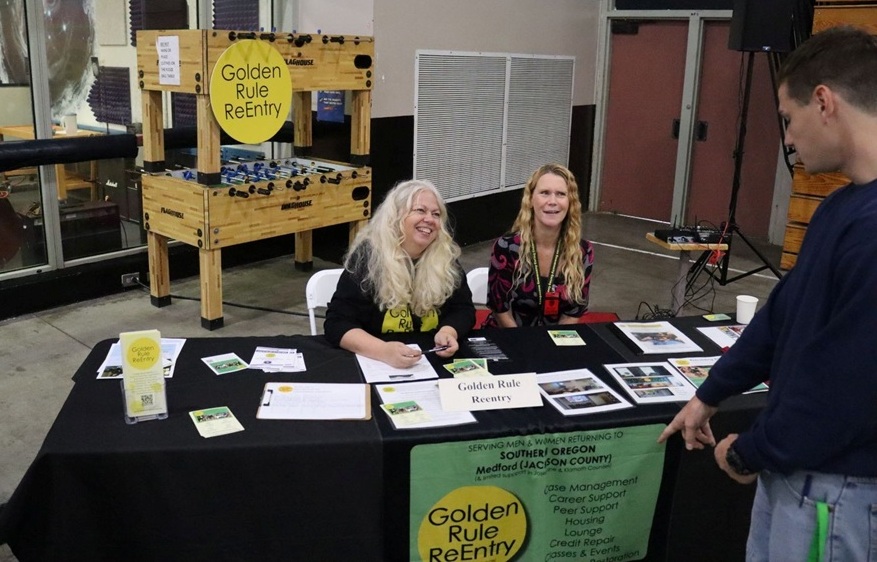
Brandi Ferreira (right) and Abigal Lewis (left) of Golden Rule ReEntry attend an event at Eastern Oregon Correctional Institution
Brandi Ferreira knows firsthand how hard it can be for people to rebuild their lives after incarceration.
After serving 12 years in prison, she was released and struggled for months to rent an apartment for herself and her child. Ferreira had to compete with applicants who had much higher incomes, better credit scores and no criminal record. She faced a lot of rejection before landing a place to live. With her self-esteem at rock bottom — and knowing how hard it is for those formerly incarcerated to find work — looking for a job wasn’t easy either.
“Many people leave prison with their confidence shattered,” she said. “We’re traumatized after years of being told we don’t matter, and we’re expected to apply for jobs and believe in ourselves when we’ve been broken down.”
Today, she is a Career Pathways Case Manager and Peer Support Specialist at Golden Rule ReEntry. The organization is one of 28 nonprofits serving Jackson County that were awarded grants from Jackson Care Connect (JCC) this year.
Golden Rule provides the kind of support to formerly incarcerated people that Ferreira wishes she would have had after her release. Most of its staff have personal experience with incarceration and reentering society.
“I’ve been where our clients are, and I’m really passionate about helping them,” said Ferreira, who regularly visits adults in custody to help them prepare for release by connecting to jobs, housing and other resources.
Addressing critical needs
JCC’s 2026 grants help sustain and expand programs addressing some of Jackson County’s most critical health-related needs. The funding will improve access to physical and mental health care, substance use disorder treatment and community-building initiatives. It also provides greater access to many types of housing, from emergency shelter to affordable, owner-occupied homes.
The awards were approved during a joint funding cycle for the state’s Supporting Health for All through REinvestment (SHARE) initiative and the JCC Community Health Improvement Plan (CHIP) grant program. (Find a full list of grant recipients below.)
Community voices shape investment priorities
Grant focus areas are based on extensive community input. In addition, JCC’s Community Advisory Council played a key role in selecting grant recipients, choosing eight of the approved grants and making recommendations on the rest of the awards.
“Our grant priority areas come directly from the folks we serve.”
— Samantha Watson, JCC Director of Community Health Partnerships
Boosting success for women reentering society
Today, about 85% of Golden Rule’s clients are men. But the JCC grant will help the nonprofit serve greater numbers of women returning to Jackson County after incarceration. The funding will help pay for improvements to Golden Rule’s first-ever women’s transitional house, scheduled to open in the spring of 2027.
Located on the same block as Golden Rule’s drop-in center in Medford, the house will accommodate up to five women at a time, with the average stay lasting about 18 months. It will provide clients with a safe, stable place to live after release. The house will also grant easy access to a wide range of services — from parenting and employment-related classes to medical and mental health care through La Clinica’s mobile health program.
“Many people face barriers to housing, job opportunities, health care and other critical needs, but those barriers are magnified for folks coming out of incarceration,” said Watson.
“It’s really important for women coming out of incarceration to have a place where they can focus on healing, rebuilding connections and figuring out their next steps without having to worry about where they’re going to sleep at night,” she added.
A sustained commitment to improving access to care
Improving access to care has long been a priority for JCC and its clinical and community partners. While meaningful progress has been made, there’s still work to do, said Watson.
Patients may face long waits for certain types of care, and in some cases, they must travel outside the county to get care that isn’t available locally. Limited public transportation, long drive times, language and cultural barriers, and fear and mistrust around systems of care also create barriers.
“There’s a misperception that because someone has health insurance, they have access to care. There are many different factors that keep people from getting the care they need,” said Watson.
Bringing care directly to underserved communities
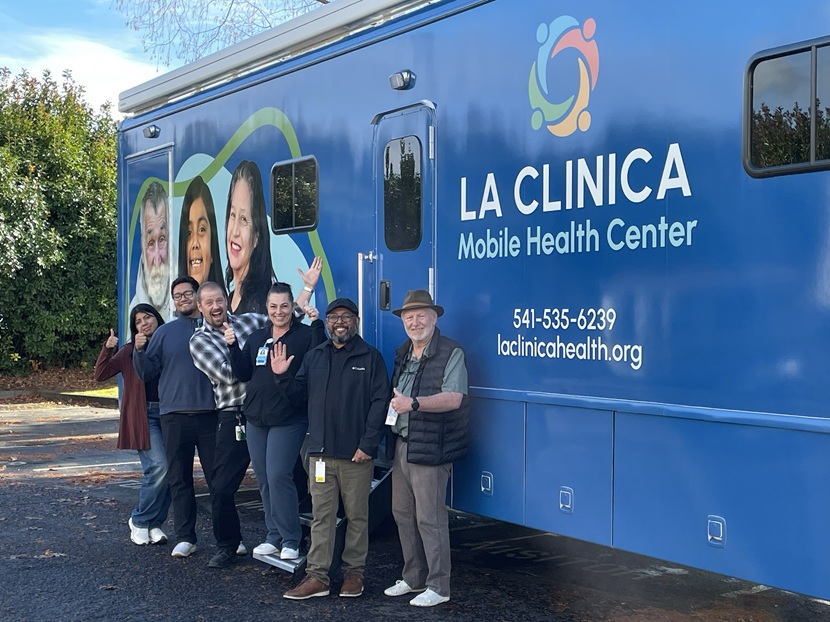
JCC grants to two mobile health programs are helping to bring trauma-informed, culturally responsive care directly to underserved communities, including formerly incarcerated people, migrant farm workers, people experiencing houselessness and LGBTQ+ individuals.
JCC awarded a grant to La Clinica for its mobile health center — a “clinic on wheels” that regularly visits migrant farm worker camps, food pantries and other locations where community members gather for services and support. The mobile clinic makes two site visits a day in Medford and surrounding communities. This is especially important in Jackson County, where high unemployment and lower-than-average wages make access to care difficult for many people in the community.
The mobile health team provides medical, dental and behavioral health care out of a custom-built, 38-foot-long recreational vehicle. Care is offered on a sliding-fee scale, but no one is turned away based on ability to pay.
The team works to build trust through conversation, gently engaging community members to find out what they need most. Very often, that’s medical care, but it may also be support with food, housing and other social needs.
“Often when folks come to our mobile clinic, their primary focus is medical care, but sometimes their food or housing situation is more important to them,” said Zulma Larios, a Field-based Care Manager at La Clinica.
“Until their [social] needs are addressed, they may not have the capacity to take care of their medical needs,” she added.
Improving lives through dental care
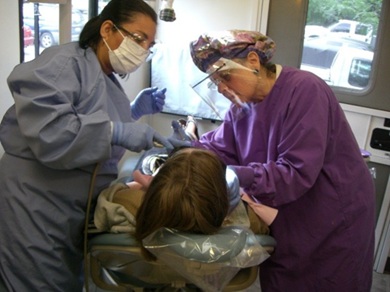
This year, JCC awarded its first-ever grant to a mobile dental care program run by Providence Health and Medical Teams International. The program partners with community-based organizations — including NOWIA Unete (Center for Farm Worker Advocacy) in Southern Oregon — to identify people living with pain and provide them with free urgent care.
Volunteer dentists, hygienists, nurses and clinic managers work out of a fleet of dental vans. The teams provide extractions, fillings and other types of dental care, as well as preventive-health screenings and referrals to follow-up care. Very often, there’s a wait list for care, said Zainab Kamara, a Program Manager in the Community Health division of Providence.
“It’s about trying to reach those who have the most barriers to care and improve their daily lives as much as possible,” said Kamara, who has seen how dental care can change lives.
One patient, she recalls, had been using super glue to hold together a cracked tooth until she was able to get care through the mobile program.
Limited access to dental care affects more than just oral health. Untreated dental problems can lead to serious health issues as well as difficulty eating, working and engaging in family and community life.
“It’s a powerful program making a huge difference in people’s lives.”
— Zainab Kamara
Dental care in short supply
It’s not hard to see why some people find themselves in such difficult circumstances. In Southern Oregon and other parts of the state, dental care can be even harder to get than medical care because of provider shortages, low rates of Medicaid acceptance and long drive times to clinics. In fact, most Oregon counties have been designated as dental-health professional shortage areas, according to 2025 Oregon Health Authority data.
Even for people who have commercial dental insurance, out-of-pocket costs can make care unaffordable.
“I don’t think many people realize the connection between oral health and overall health. Untreated dental problems can impact people’s ability to lead full, healthy lives,” said Watson.
Investing for the long term
Through partnerships and investments, JCC is supporting community-led solutions to many of Jackson County’s toughest challenges. Even modest investments, said Watson, can make a meaningful and lasting difference at a time when local nonprofits are facing growing community needs and scarcer funding options.
“Our investment priorities reflect what our community needs right now and what it needs to build long-term health and stability for years to come,” she said.
All 2026 CHIP and SHARE grant recipients
Ashland/Talent Conference of St. Vincent de Paul: Grant supports same-day emergency assistance to individuals and families to prevent evictions and/or utility shutoffs.
Ballet Folklorico Ritmo Alegre: Grant supports community wellness and leadership series to improve health, economic stability and leadership skills among underserved families.
Butte Falls Community School Partnership: Grant supports opportunities for education, enrichment and community building for residents of all ages.
Coalición Fortaleza: Grant supports community-designed initiative that helps Latinx families thrive.
Continuum Behavioral Health & Recovery Services: Grant supports purchase of a vehicle to transport Emergency Lodging clients to health care appointments. Emergency lodging provides safe housing to people who are unhoused and awaiting treatment beds, with priority given to pregnant and postpartum women.
Jackson County Continuum of Care: Grant supports Jackson County Point-in-Time Count. The count collects data on individuals experiencing homelessness, providing critical insights for resource allocation, policy development and community-support strategies.
Flourish Anyway: Grant supports a peer-led recovery program for women ages 18 and older. Program offers wellness groups, family-inclusive recovery support, mindfulness education and resource navigation.
Freedom Farms: Grant supports a workforce-development training program focusing on land-conservation management for youth (ages 16-24) who have been incarcerated or are at risk of justice-system involvement.
Golden Rule ReEntry: Grant supports a transitional-housing project for formerly incarcerated women. Golden Rule fosters connection through kinship, networking, classes and services.
Habitat for Humanity Rogue Valley: Grant supports the purchase materials for the construction of accessibility ramps, helping older adults and people with disabilities safely remain in their homes and access care.
Housing Authority of Jackson County: Grant supports childcare scholarships offered through the authority’s resident-services department. The scholarships allow parents to continue their education, return to work and/or extend work hours, improving their financial stability.
Jackson County Community Long-Term Recovery Group: Grant supports regional capacity to develop and preserve affordable rental housing in Southern Oregon.
La Clinica: Grant supports mobile health center providing medical, behavioral health and dental care as well as social-support services to underserved residents.
Listo Family Literacy Program (Southern Oregon Head Start): Grant supports a program providing culturally specific education, leadership training and behavioral health and wellness support for Spanish-speaking and Latinx families.
Meant 2 Serve: Grant supports the Nu’u Senior Circle, a culturally grounded, community‑centered program for Pacific Islander adults 55 and older.
NOWIA Unete (Center for Farmworker Advocacy): Grant supports the purchase of culturally appropriate food for the nonprofit’s food bank. The food bank serves about 300 individuals a month, and demand is expected to rise as more people struggle to afford food, gas and other essentials.
Painted Horse Recovery: Grant supports the development of a culturally grounded sweat lodge designed to improve behavioral health outcomes through connection to culture, community and healing practices.
The Parker House: Grant supports transitional housing for up to five women (including women with children) at a time.
Pink Lemonade Project: Grant supports a breast-cancer-specific curriculum and training program for community health workers.
Providence Health/Medical Teams International: Grant supports jointly operated mobile dental care program serving uninsured and underinsured individuals.
Rogue Trans: Grant supports comprehensive services for transgender and non-binary individuals and their families across the Rogue Valley and parts of Northern California.
Rogue Valley Mentoring: Grant supports program pairing youth (ages 9-24) with trained, volunteer adult mentors. Organization serves young people facing significant barriers, including youth experiencing houselessness or involved in the foster-care system.
Samoa Pacific Development Corp.: Grant supports Pacific Islander Youth Empowerment program, ensuring uninterrupted access to culturally specific, school- and community-based support for youth and families.
SMART Reading: Grant supports an early-literacy program pairing young children with trained volunteers for weekly reading sessions. Children get free books. During the 2026-27 school year, the program expects to serve about 660 students across 23 schools and preschools.
Southern Oregon Regional Health Equity Coalition: Grant supports Noche en Comunidad (Community Night) program. The monthly events serve Spanish-speaking, low-income families with children who face barriers to food and health care. Families receive plain-language information about navigating care, food benefits and more.
Song for Charlie: Grant supports The New Drug Talk: Jackson County Community Prevention Initiative. The family-driven education program is designed to reduce youth substance use and overdose by equipping parents and caregivers with tools to take action early.
Southern Oregon Center for Community Partnerships: Grant supports Food & Friends program providing nutritious meals to older adults. The program serves older adults who are at high risk of malnutrition, food insecurity, loneliness, isolation and depression.
Southern Oregon Success: Grant supports quarterly trainings — from conflict resolution to mental health first aid — for navigators working in health care, behavioral health care, education and social services.
